

Screening a porch is one of the oldest ways to take back a New Orleans evening from the mosquitoes. If your house sits in one of the city’s local historic districts, though, a screened porch isn’t a simple weekend upgrade. The Historic District Landmarks Commission (HDLC) reviews exterior work in those districts, and its design guidelines treat screens on a porch the way they treat walls or glass.
This guide covers what the HDLC reviews and where a screened space can still work on a historic property. It’s general information drawn from the city’s HDLC pages and design guidelines, not a ruling on your house, so confirm your property’s district and rating with HDLC staff first. For the bigger choice between screens and glass, start with our guide to enclosing a patio in the New Orleans metro.
Key takeaways
- The HDLC’s guideline glossary says a screened-in porch is considered an enclosed porch.
- Its porch guidelines state that the HDLC does not permit enclosing any “porch, gallery or balcony that is visible from the public right-of-way.”
- In full control districts, all exterior work except paint color and plantings goes to the HDLC before work starts, while several partial control districts are reviewed for demolition only.
- Inside local historic districts, HDLC jurisdiction is limited to the parts of a property visible from a public right-of-way.
- The French Quarter is a separate case, because the Vieux Carré Commission reviews work there.
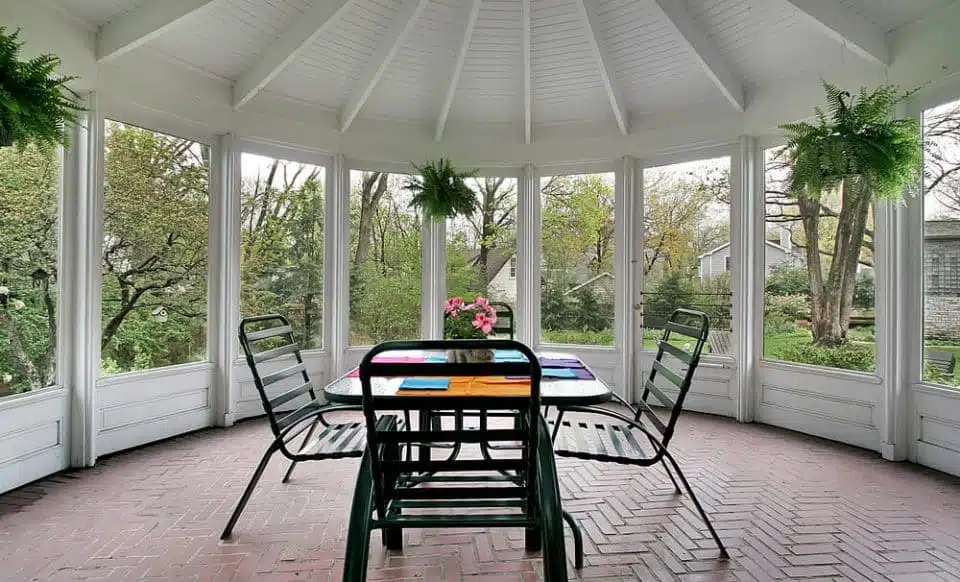
Does the HDLC treat a screened porch in New Orleans as an enclosure?
On paper, yes. The glossary in the HDLC’s design guidelines defines an enclosed porch as one “enclosed by walls, screens, lattice or other material,” and it states that “a screened-in porch is considered an enclosed porch.” You might picture screen panels as a light touch, but the guidelines file them next to glass walls and solid infill.
The porch chapter explains why. Porches and galleries were meant to be open exterior spaces, and the guidelines call enclosing them, particularly where visible from the street, “a radical alteration to a building.” The same page draws the line: “The HDLC does not permit enclosing of any porch, gallery or balcony that is visible from the public right-of-way.”
That page’s review table still lists enclosing a porch as a review item. Significant and Contributing buildings go to the full Commission for it, and Non-Contributing buildings go to HDLC staff. Treat the written policy and the table as the start of a conversation with staff, never as a loophole.
Which New Orleans historic districts does the HDLC fully control?
In a full control district, the guidelines say “all exterior work, excluding paint color and plantings, must be submitted to the HDLC for review and approval prior to commencing work.” In a partial control district, the City Council set the HDLC’s reach district by district, and it can be as narrow as demolition review. Here’s how the jurisdiction chart in the January 2019 guidelines lays it out. The chart itself notes it’s based on 2017 building totals and is subject to change.
- Full control: Algiers Point, Bywater, Faubourg Marigny, Holy Cross, Irish Channel, the Lower Garden District, and St. Charles Avenue, plus the Carrollton Avenue and Esplanade Avenue frontages and the river side of Claiborne Avenue in Tremé. Canal Street, Lafayette Square, Picayune Place, and the Warehouse District are also full control under the separate Central Business District commission.
- Partial control, demolition only: Carrollton, Mid-City, Parkview, and Uptown.
- Partial control with more review: the Garden District adds demolition by neglect and new construction, while Esplanade Ridge and the lake side of Claiborne in Tremé add demolition by neglect plus a review and comment step.
So a raised double deep in Uptown and a shotgun in Bywater face different levels of control before anyone looks at the porch. If you don’t know your district or your building’s rating, ask HDLC staff before you sketch anything. Our New Orleans service area page explains how we plan work in older neighborhoods.
Rear porches and the visibility rule
The guidelines say “within local Historic Districts, the HDLC jurisdiction is limited to areas of properties that are visible from a public right-of-way.” A front gallery facing the street is visible by definition. A back porch tucked behind the house may not be, though corner lots and side yards along an alley complicate that picture.
Staying out of view doesn’t let a project skip the city’s building permit. Separately, the guidelines send new construction over 500 square feet, including accessory structures and additions, to the Architectural Review Committee and the full Commission, so ask staff how that rule applies to a larger rear structure. In practice, the most workable screen projects on historic properties often sit at the back of the lot, under a new or existing cover the street can’t see. Whether your porch counts as visible is HDLC staff’s call, not ours. When a rear screen room makes sense, our New Orleans screen rooms page shows how we frame and screen them.
How the HDLC permit process starts
The HDLC’s home page says “you must apply for a building permit with the Department of Safety and Permits to start the HDLC permitting process,” and its application page repeats that you “must file for a Building Permit in order to obtain a CofA,” short for Certificate of Appropriateness. The city requires a certificate for exterior work on all buildings in local historic districts and on individually designated landmark buildings.
- The porch chapter’s review table asks for dimensioned drawings of all proposed components, with details, approved by HDLC staff before any installation or modification.
- The HDLC doesn’t collect its own fee, but the city adds a 50 percent surcharge to the permit fee and plan checking fee collected through Safety and Permits.
- The city’s building permit guide says roofs over otherwise unenclosed porches, along with their framing, aren’t exempt from permitting.
Our patio cover permit guide covers the general permit side across the metro.
The French Quarter answers to a different commission
The city says the Vieux Carré Commission’s jurisdiction “includes all private and semi-private properties within the boundaries of the Vieux Carré Historic District,” and it describes the HDLC as the agency for local districts outside the Vieux Carré. VCC applications also start at the city’s One Stop Shop, and the VCC’s standards are its own, so don’t assume an HDLC answer carries over.
Screening ideas that respect a historic house
- Screen at the back of the lot. A patio cover over a rear patio, screened with individually tensioned panels, keeps the enclosure off the historic facade. It still needs a permit.
- Ask before you pick retractable screens. Motorized screens roll out of sight when they’re up, but the guidelines we read don’t mention them by name. Ask staff whether one on a visible porch counts as an enclosure before you order.
- Choose the mesh with care. On a rear room, the weave decides whether the smallest biters get through, as our guide to choosing screen material explains.
Frequently asked questions
Can I screen my front porch in a New Orleans historic district?
In a local historic district, the HDLC’s guidelines count a screened-in porch as an enclosed porch and say the HDLC does not permit enclosing a porch visible from the public right-of-way. Ask HDLC staff how that applies to your property.
Does the HDLC review a back porch nobody can see from the street?
The guidelines limit HDLC jurisdiction in local districts to areas visible from a public right-of-way, so a hidden porch may fall outside that review. You still need a building permit, and HDLC staff make the visibility call.
Is Uptown a full control historic district?
The 2019 guideline chart lists Uptown as a partial control district reviewed for demolition. St. Charles Avenue is a full control district of its own, and the chart is subject to change, so confirm your block with the city.
Planning a screened space on an older New Orleans home? We’ll walk the property with you and build the permit and review steps into a written scope before any work starts. Call (504) 285-2659 or reach out through our contact page to set up a walkthrough.